Introduction
The revised EU GMP Annex 1 has fundamentally changed how Environmental Monitoring (EM) is expected to function in sterile pharmaceutical manufacturing. What was once considered a routine compliance activity is now a core element of contamination control strategy and product quality assurance.
Many pharmaceutical companies, however, are still operating with legacy EM programs—systems built on historical practices rather than risk-based design and data-driven decision-making. This gap creates not only compliance challenges but also real contamination risk.
An ineffective EM program is not just a regulatory weakness—it can directly impact product quality, batch release, and ultimately patient safety.
Building an effective EM program today requires more than procedures and sampling plans. It requires a structured, risk-based, and integrated approach aligned with modern regulatory expectations.

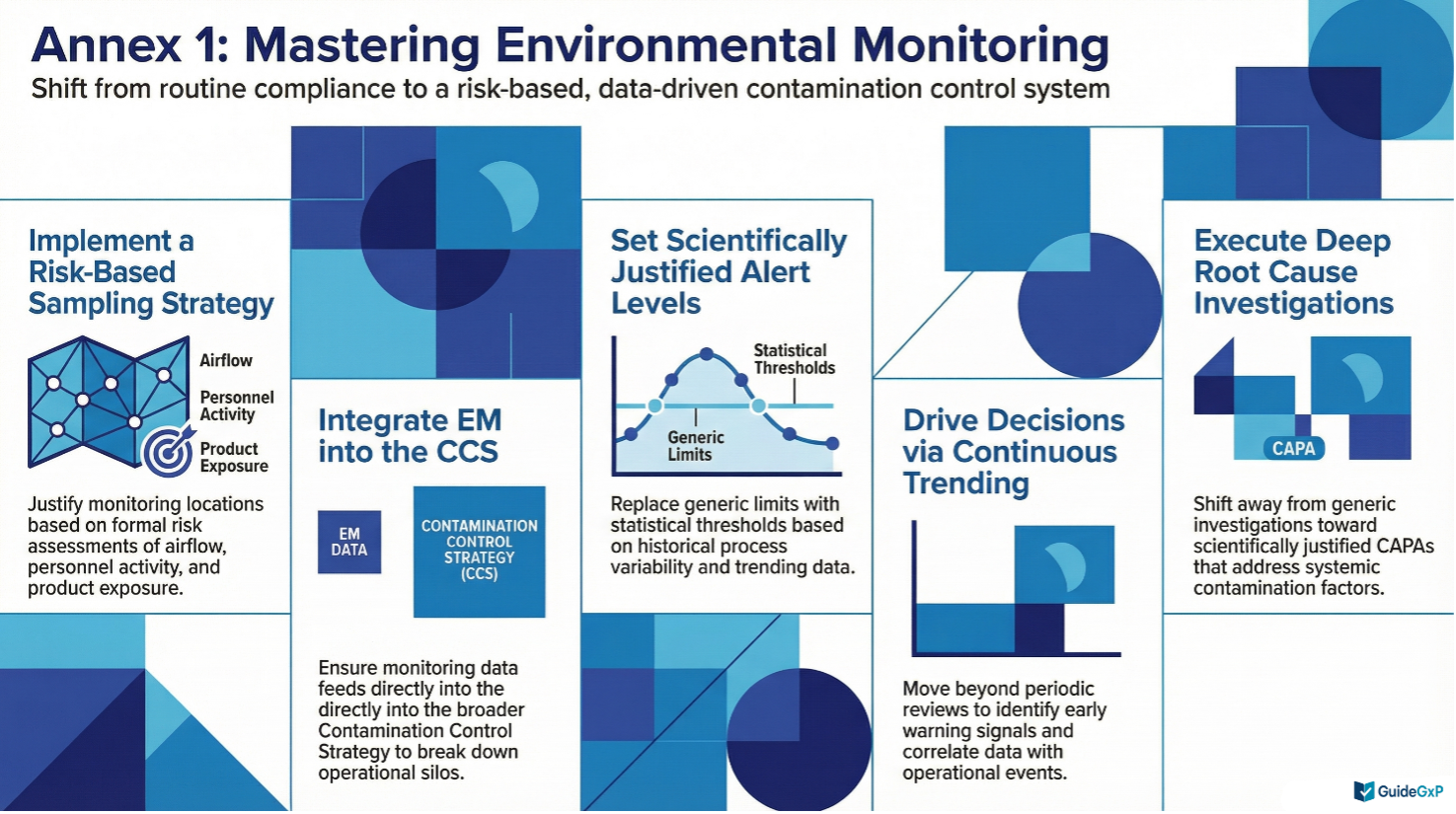
1. Start with a Risk-Based Strategy
One of the most common weaknesses in Environmental Monitoring programs is the absence of a truly risk-based foundation.
Too often, sampling locations and frequencies are defined based on legacy practices rather than structured risk assessments aligned with ICH Q9 principles.
An effective EM program should:
- Identify critical control points based on process risk and product exposure
- Define sampling strategies tailored to each cleanroom classification
- Justify monitoring locations using:
- Airflow patterns
- Personnel movement
- Equipment layout and interventions
For example, increased monitoring may be required in areas where frequent aseptic interventions occur, as these represent higher contamination risk.
Without a risk-based approach, EM becomes a routine exercise rather than a meaningful control system.
2. Stop Treating EM as a Standalone System
Under Annex 1, Environmental Monitoring is no longer an isolated microbiology activity—it is a key component of the Contamination Control Strategy (CCS).
In many organizations, EM still operates in silos, disconnected from cleaning, gowning, utilities, and operational controls. This fragmentation limits its effectiveness.
To address this, companies should:
- Ensure EM data feeds directly into CCS reviews
- Link monitoring results to:
- Cleaning and disinfection effectiveness
- HVAC performance
- Operator practices
- Establish clear ownership across QA, Microbiology, and Production
For instance, repeated environmental excursions following maintenance activities may indicate system-level issues, not isolated events.
An integrated approach transforms EM from passive monitoring into a decision-making tool.
3. Fix Your Alert and Action Levels
Another common issue is the use of alert and action levels that are not scientifically justified.
Many companies still rely on generic or inherited limits instead of using:
- Historical environmental data
- Process capability
- Area-specific variability
A more effective approach includes:
- Establishing limits based on trend analysis and statistical evaluation
- Differentiating clearly between:
- Alert levels (early warning)
- Action levels (require investigation)
- Periodically reviewing limits as process understanding improves
For example, a gradual upward trend in viable counts—even within limits—may signal deteriorating control that would be missed by static thresholds.
Alert and action levels should support proactive control, not just trigger investigations.
4. Make Your EM Data Actually Useful
Collecting Environmental Monitoring data is not enough—the real value lies in how it is interpreted and used.
A frequent gap is superficial trending, where data is reviewed periodically but not analyzed deeply.
A robust EM program should include:
- Routine and frequent trend analysis
- Identification of:
- Recurring contamination patterns
- Gradual performance drift
- Correlation with operational events such as:
- Interventions
- Maintenance activities
- Shift changes
For example, repeated spikes in Grade C areas during shift transitions may point to gowning or personnel behavior issues.
Structured approaches and practical tools (e.g. https://www.guidegxp.com) can significantly improve how EM data is used to support GMP decision-making.
Ultimately, EM data should not just confirm compliance—it should drive continuous improvement.
5. Don’t Let Investigations Become a Checkbox Exercise
Environmental excursions are inevitable. What matters is how effectively they are investigated and addressed.
In many cases, investigations are:
- Too generic
- Focused only on immediate causes
- Lacking true root cause analysis
To improve effectiveness:
- Apply risk-based investigation approaches, considering:
- Proximity to product exposure
- Frequency and trends
- Use structured root cause methodologies (e.g., 5 Whys, fishbone analysis)
- Look beyond immediate causes to identify systemic issues
For example, repeated contamination events may reflect facility design limitations, airflow disturbances, or human factors, rather than isolated operator error.
CAPAs should be:
- Measurable
- Effectiveness-verified
- Focused on long-term improvement
Weak investigations can undermine even the most well-designed EM program.
Conclusion
Under the revised Annex 1, Environmental Monitoring is no longer just a compliance requirement—it is a critical control system for sterile manufacturing.
To be effective, EM programs must evolve into:
- Risk-based frameworks
- Integrated components of the CCS
- Data-driven decision tools
In the Annex 1 era, Environmental Monitoring is not about collecting data—it is about understanding and controlling contamination risk.
Companies that embrace this shift will not only meet regulatory expectations but also achieve stronger process control, reduced contamination risk, and improved product quality.